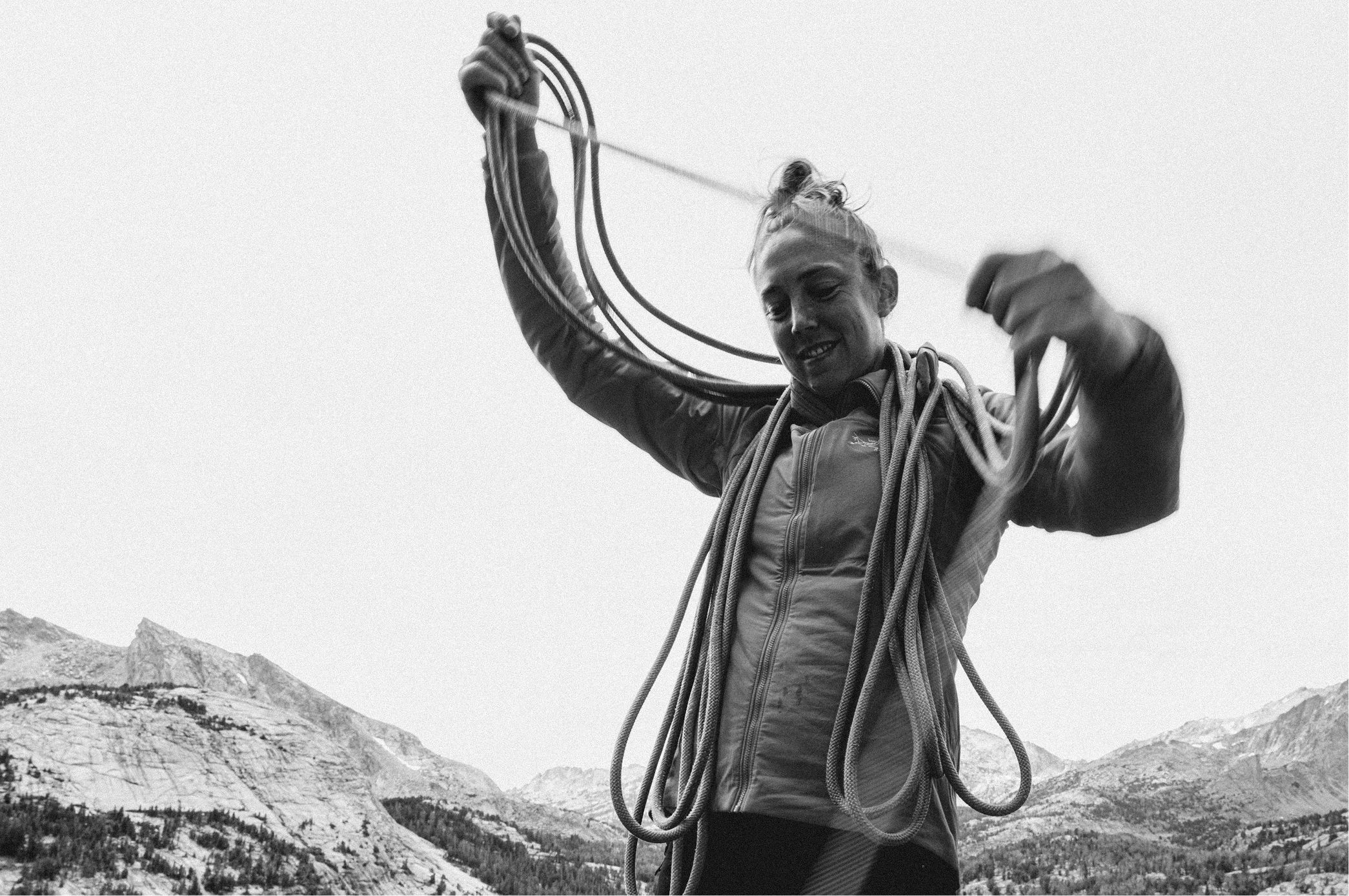



Words by Andrew Bisharat | Photography by Ian Dzilenski
In the Wind River Range of Wyoming, Amity Martin set out to answer one of climbing’s oldest questions — and found more than she expected.
Some routes take generations to climb. Long after the first piton is placed and the summit reached, these climbs ask a simple question that captures every climber’s imagination: Can this be done better?
The Lowe-Spark on Haystack Mountain in Wyoming’s Wind River Range is one of those routes. Few climbers have heard of it, but this remote 364-metre alpine wall of fine-grained granite has attracted some of the sport’s finest.
In July 2025, Arc’teryx athlete Amity Martin and Arc’teryx climbing team trainer Joel Unema achieved the first team-free ascent of this 12-pitch 5.13b rock climb — more than 56 years after the route’s first ascent by aid.
“This was the first time I’ve done a ‘team-free’ ascent, because I’ve always wanted to lead all the crux pitches,” says Amity. “I was really psyched to do this route, but this style certainly wasn’t how I imagined it going while hiking in.”
Style has always been central to how Amity climbs. On each of her five ground-up free ascents of El Capitan in Yosemite, she’s led every crux pitch herself — a higher bar than “team-free” style requires, which only asks that one partner lead each pitch free. She’s also avoided the tactics that have become standard in Yosemite big-wall climbing: previewing cruxes on rappel, relying heavily on stances, and working pitches on Mini Traxion for days or weeks before a lead attempt. Above all, her personal ethics dictate that she report her tactics completely and honestly every time. In an era where shortcuts seem to be getting more popular, Amity’s approach has stood out.
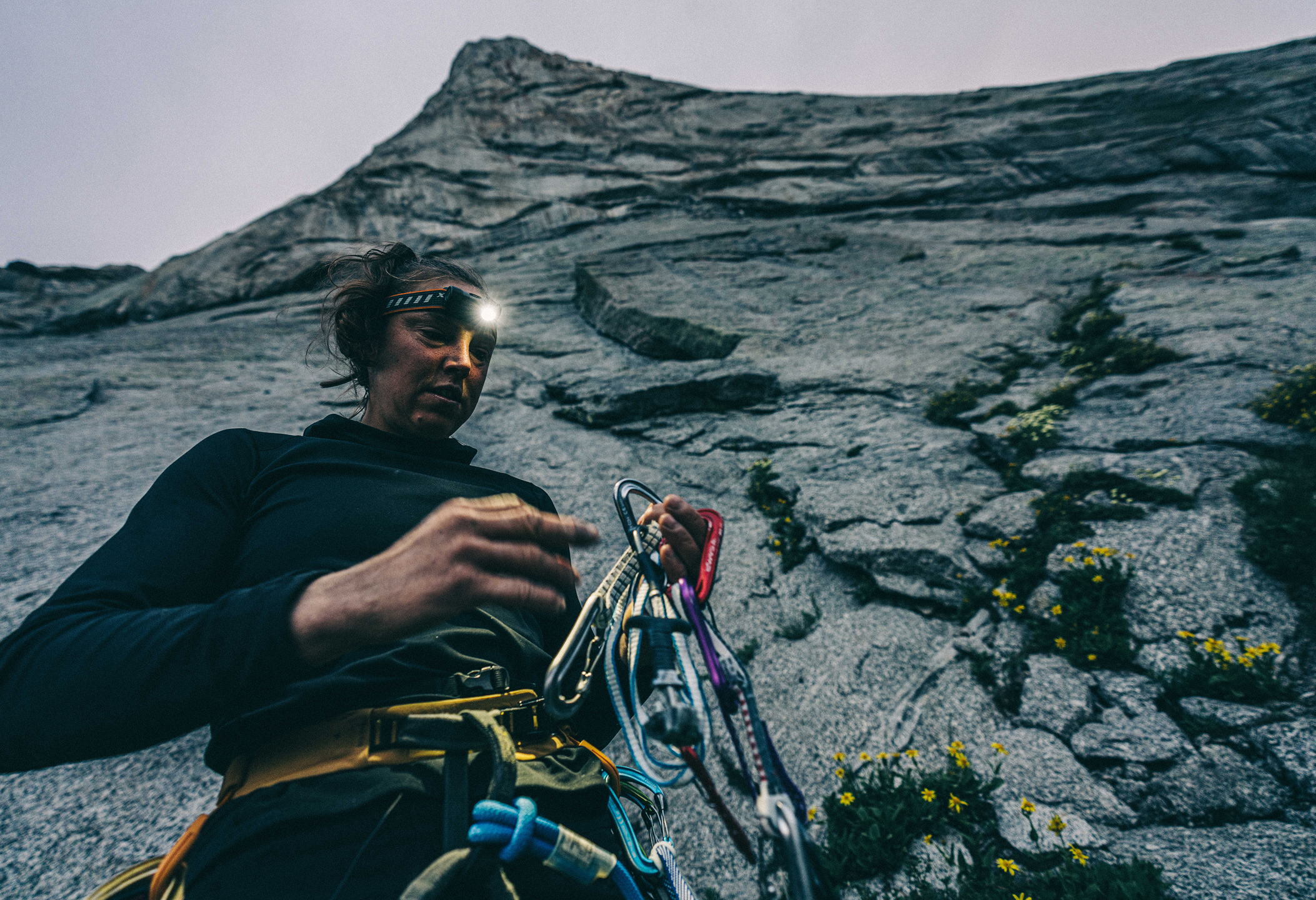
“I was really psyched to do this route, but this style certainly wasn’t how I imagined it going while hiking in.”
“Choosing climbs that are hard or scary — where I don’t know if I can do it — then putting in the work to overcome self-doubt and raise myself up to the climb’s level is what I enjoy about this approach,” says Amity. “I’ve never wanted to settle for good enough.”
With the Lowe-Spark, however, Amity encountered a circumstance that forced her to reconsider her normal style. The Lowe-Spark contains two cruxes: a 5.13b on pitch 4 and a 5.13b on pitch 7. The crux on pitch 7 came down to a single, height-dependent move. The taller Joel could span the holds, but Amity, with her shorter wingspan, couldn’t make the reach.
“For me, it was a super low-percentage, all-points-off dyno,” says Amity, who tried the move several times, hucking her whole body across the blank slab. She realized that while the move might be possible, she was unlikely to pull it off within the time frame she and Joel had scheduled.
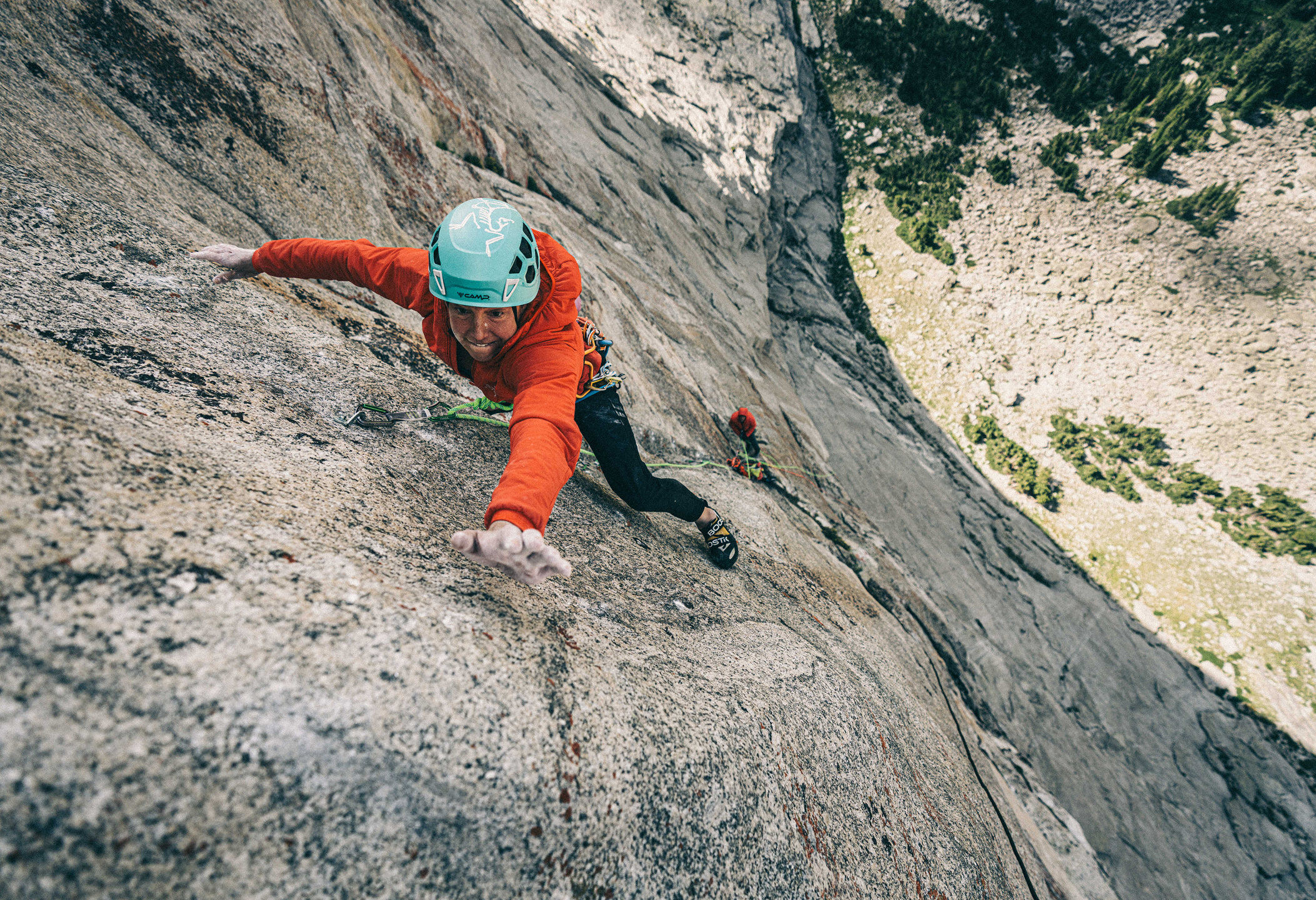
The height-dependent crux move on pitch 7, 5.13b.
“Switching to a team-free style was a big decision for me,” says Amity. “Part of me was like, ‘I’m settling.’ But I also realized this question is only really important to me personally.”
“She tried really hard and gave it everything,” says Joel. “Even after she decided the move was too reachy, she kept giving it more effort because that’s her personality.”
With one day left in their trip to climb the route, Amity quietly wrestled with the question of style. By night, her anxiety about pitch 7 hushed under the wide, starry sky. Amity sat with Joel, and two other friends, around a campfire and roasted tortillas on sticks. The air was full of laughter and camaraderie, the smell of toasted masa and pine, and the numinous presence of those who had come before.
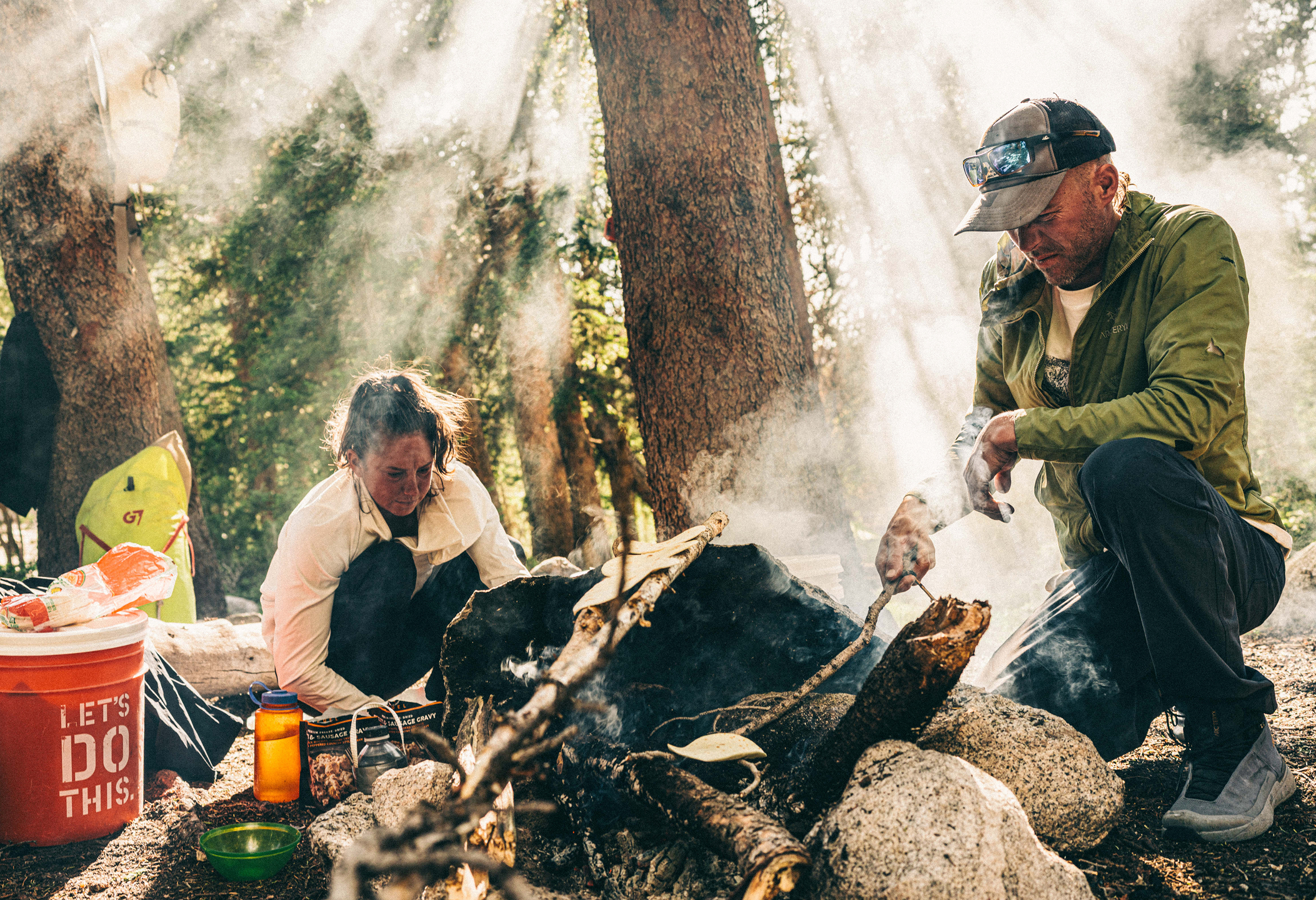
The daily ritual: roasting tortillas on a campfire.
Climbing among the ghosts
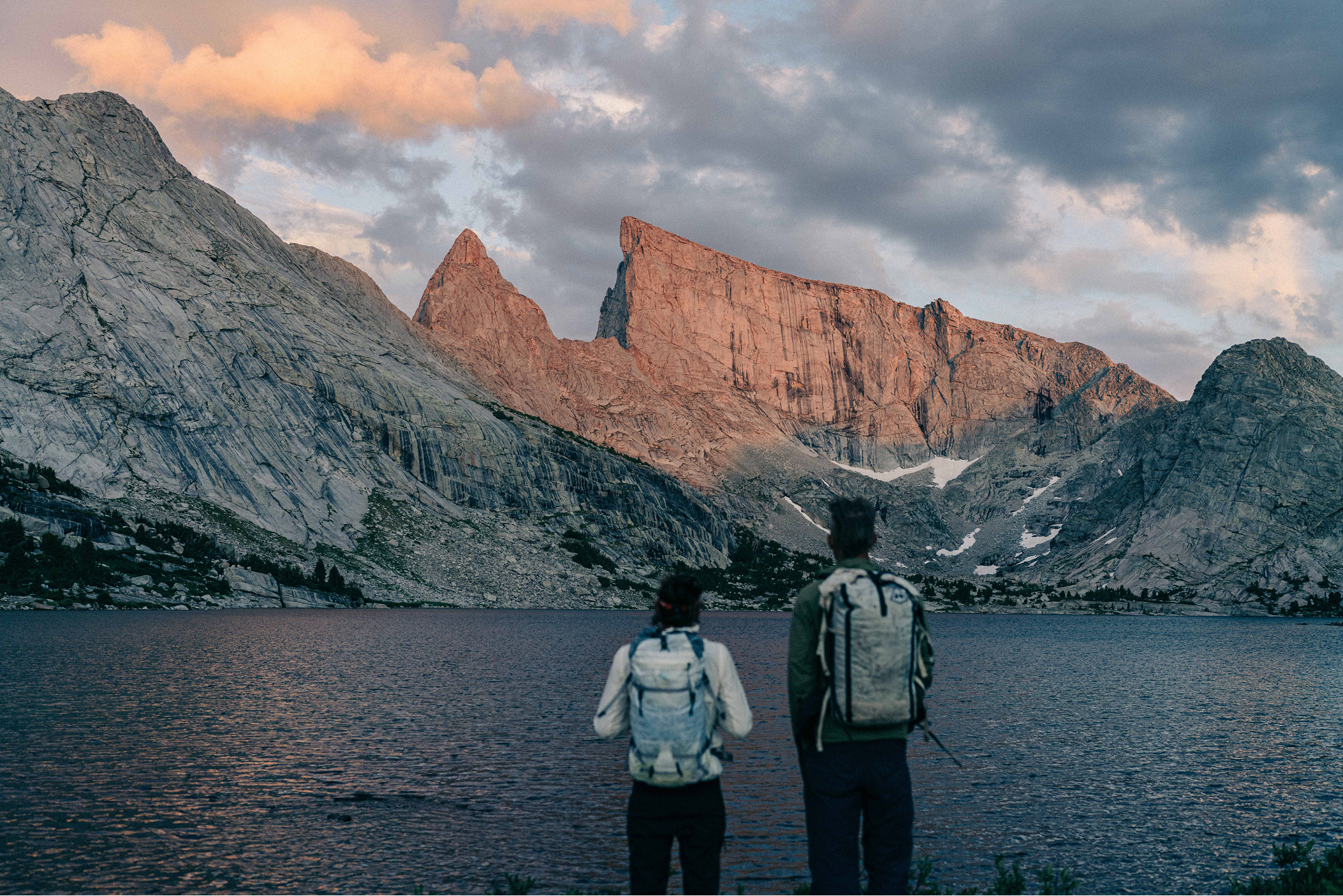
Located in the Deep Lake Area of Wyoming’s Wind River Range, Haystack Mountain stands amid a cirque of imposing, jagged peaks — all with sheer, vertical faces rising above the tree line. A minimum three-hour approach drops you into this other world, where all you see are the formidable walls themselves, rising high into the sky and reflecting perfectly in glassy lakes pooling at the cirque’s nadir.
The Winds are one of North America’s great wilderness ranges — vast, roadless, and largely indifferent to the people who pass through them. This land carries its own deeper timeline: the Eastern Shoshone and their ancestors have called these mountains home for thousands of years, long before the first piton was ever placed.
The Lowe-Spark follows a discontinuous line of slabs, cracks, and roofs on the north face of Haystack. In 1969, Jeff Lowe and Geoff Heath made the first ascent. They were just teenagers, and it took three days. They accidentally brought only one hammock, leaving Lowe to sleep in a belay seat with slings rigged to keep him upright. Their ground-up push required hard aid climbing with rudimentary, homemade equipment, as well as free climbing on runout 5.11 slabs.
It was quite cutting-edge for the time, and even Lowe recalled feeling in top form. “I’m climbing in my own myth now,” he wrote. “I push myself right to my limits when aid would have been easy and just as fast.”
The ascent foreshadowed the legacy Lowe would leave on climbing, which included over 1,000 first ascents worldwide and the invention of modern mixed climbing. Later in life, he battled a rare neurological disease similar to ALS for 18 years before dying at age 67 in 2018, but not before he got to see his old route free climbed by the next generation.
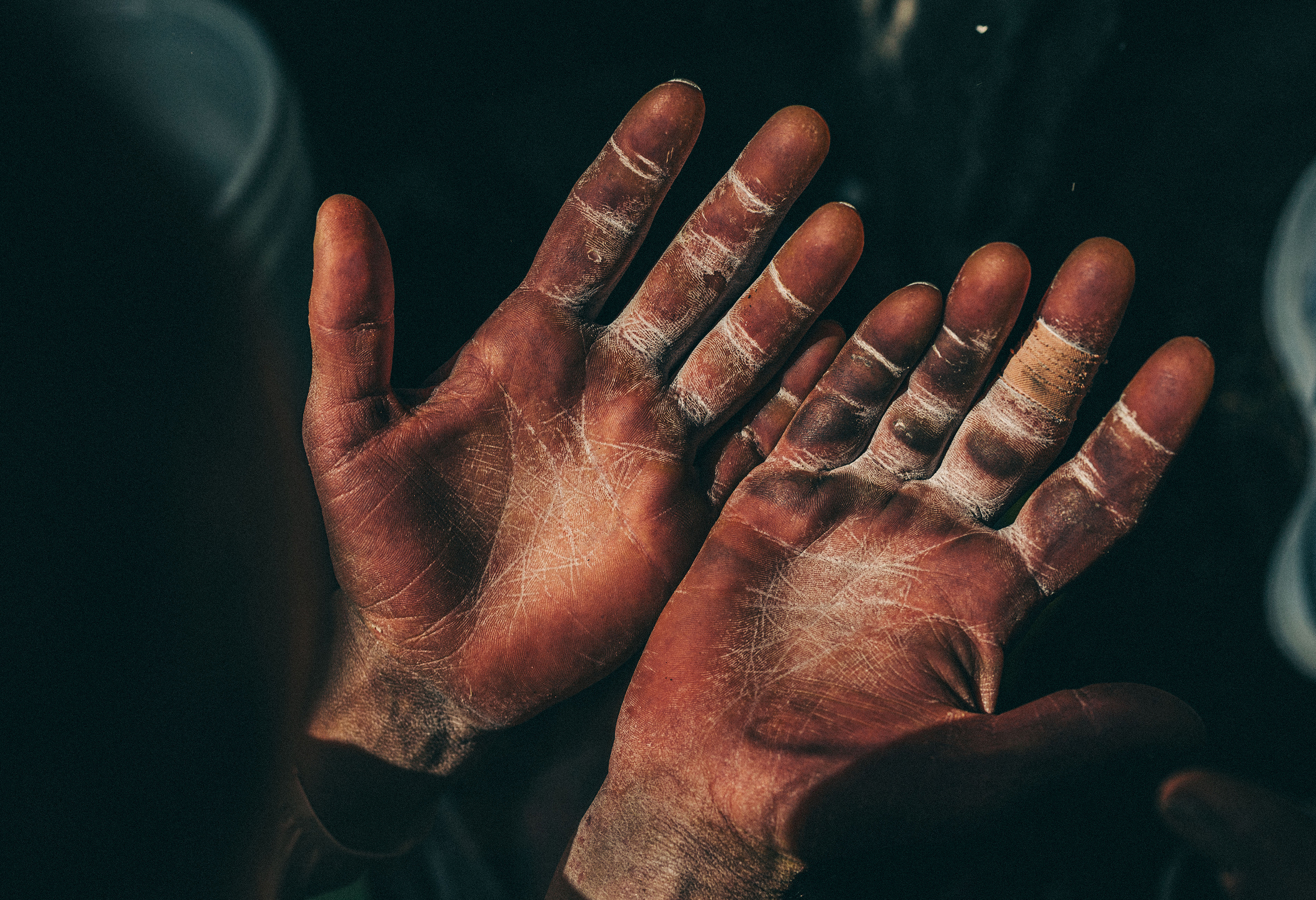
Amity’s hands after a day on the wall.
The route languished in obscurity for decades until Lander, Wyoming-based trainer and climbing legend Steve Bechtel dusted it off. Over a few weeks, he found free variations to a few pitches, placed a handful of bolts, and advanced the work toward a free climb.
In 2013, Hayden Kennedy, Kyle Dempster, and Justin Griffin picked up the baton from Bechtel and carried it further. They freed every pitch except for one aid move on pitch 4. In the aftermath of their ascent, the preternaturally exuberant Kennedy declared the Lowe-Spark, “By far one of the best alpine rock routes in the US!”
The next year, in 2014, Josh Wharton, one of America’s top all-around climbers, figured out a sequence to unlock the final aid move on pitch 4, at last freeing the wall. However, he and his partner had to bail due to a huge thunderstorm before reaching the top, leaving the climb open for the next team to complete a true free ascent from the ground to the summit.
Each of these efforts pushed style forward while leaving the subsequent party in awe of what came before. Justin Griffin captured this phenomenon when he wrote: “The truly awesome part of this route is how it has connected multiple generations’ effort and vision.”
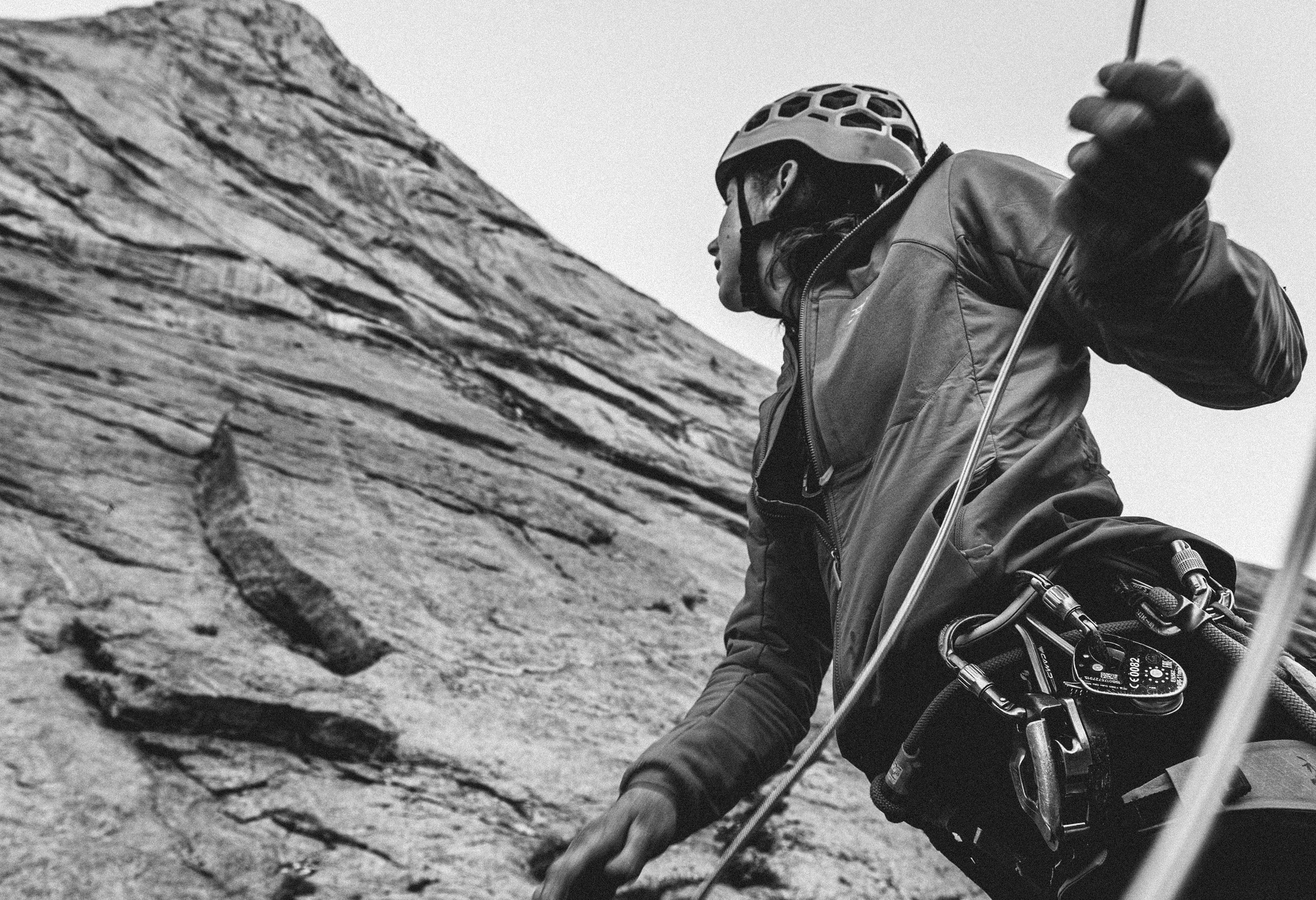
“The truly awesome part of this route is how it has connected multiple generations’ effort and vision.”
Griffin, Dempster, and Kennedy were three of the world’s most accomplished alpinists. Sadly, each died in a separate, tragic accident over consecutive years, from 2015 to 2017. This was one of the last routes the three climbers and friends shared together. Kennedy wrote: “We spent 10 days living in the mountains, eating bacon straight off the cast iron and shooting whisky over truths and lies. We climbed our brains out on the Lowe-Spark. More important, we felt a certain spirit, a palpable connection that transcended the climbing.”
Climbing style is simply a description of how a route is achieved. But to climbers, it goes much deeper than that. The curious pursuit of incremental improvement — each generation going freer and moving faster, advancing the baton forward — becomes a kind of spiritual connective tissue among climbers over time, linking them to one another in ways that defy easy explanation.
Wharton nearly carried that baton to the top, but still left room to go further and do better. During a training session one day, Wharton mentioned the Lowe-Spark to Amity, his friend and fellow Coloradan. She, too, grew curious, and that age-old question took hold in her imagination. Could she climb this route in the best style that her abilities allowed?
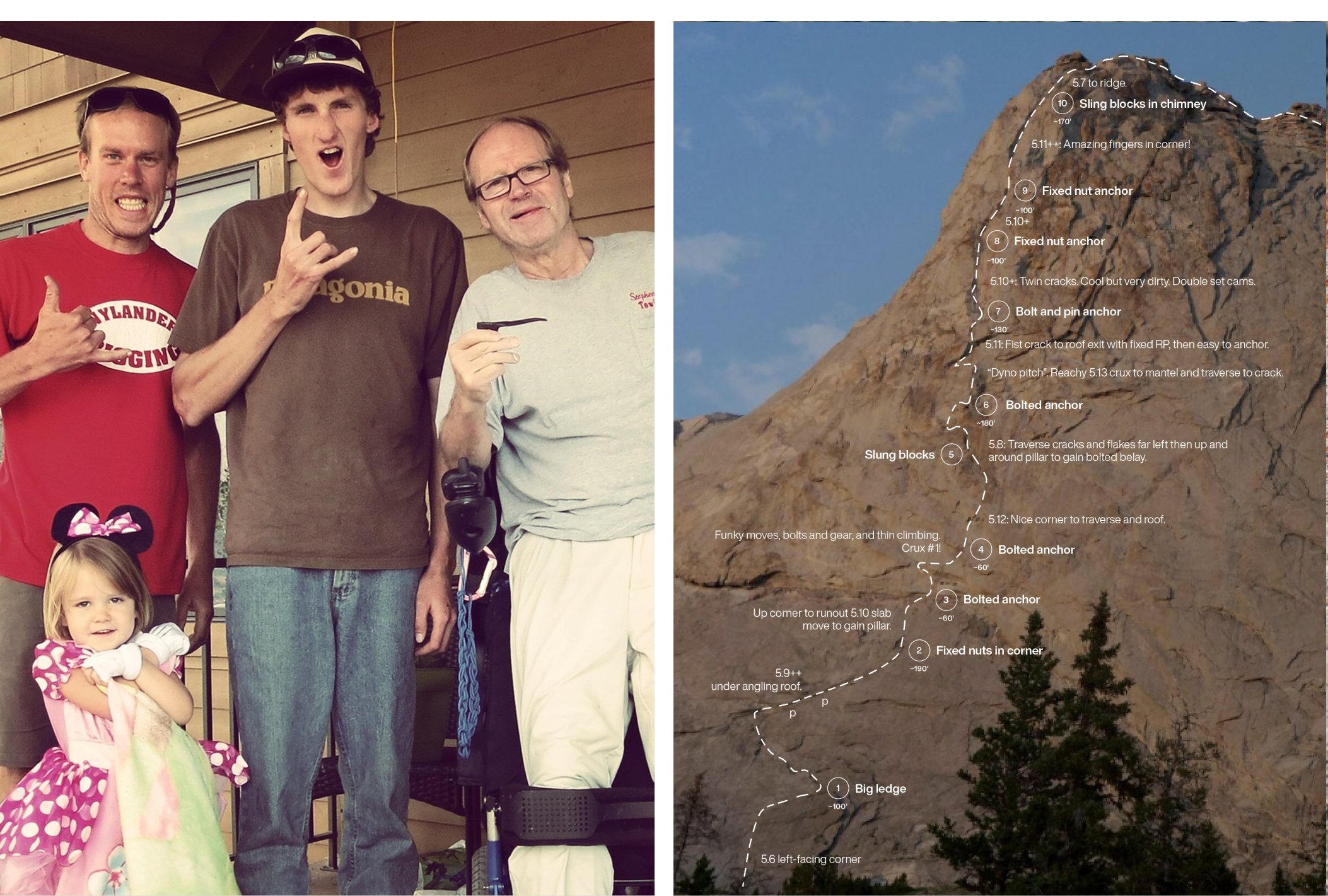
Left: After their ascent, Kyle Dempster and Hayden Kennedy visited Jeff Lowe to return some of his pitons from his first ascent. Mini Mouse approved. Photo: Hayden Kennedy collection. Right: The Lowe-Spark topo, with Amity’s annotations.
Carry the wind forward
On their push, Amity led the first crux 5.13b pitch — a pitch that Joel found too hard.
“It has the fewest handholds I’ve ever used on a 5.13,” he says. “Your feet are a couple of inches above the lip of a roof, traversing sideways on exposed slab. No down-pulling holds. Just thumbing crystals. It’s incredibly exposed!”
Joel, meanwhile, led the upper 5.13b that Amity had found too reachy. Together, they completed the first team-free ascent of the Lowe-Spark — climbing the wall in the best and most continuous style yet. It was, by Amity’s own exacting standards, something of a concession. And yet, she was surprised to discover that this experience had given her more than she’d expected. The route demanded that she expand her definition of what a climbing achievement could be. And it connected her to a deeper history, one where she and Joel were honored to add their own mark.
“We wouldn’t have sent that route without each other,” says Joel. “It felt like a cool way to send a historic route. A throwback in style, not a compromise.”
Near the top, Amity found a small hex fixed to the wall, cold and patient. It was likely original gear from Jeff Lowe’s 1969 ascent. She unclipped it and brought it home, hanging it from her van’s rearview mirror.
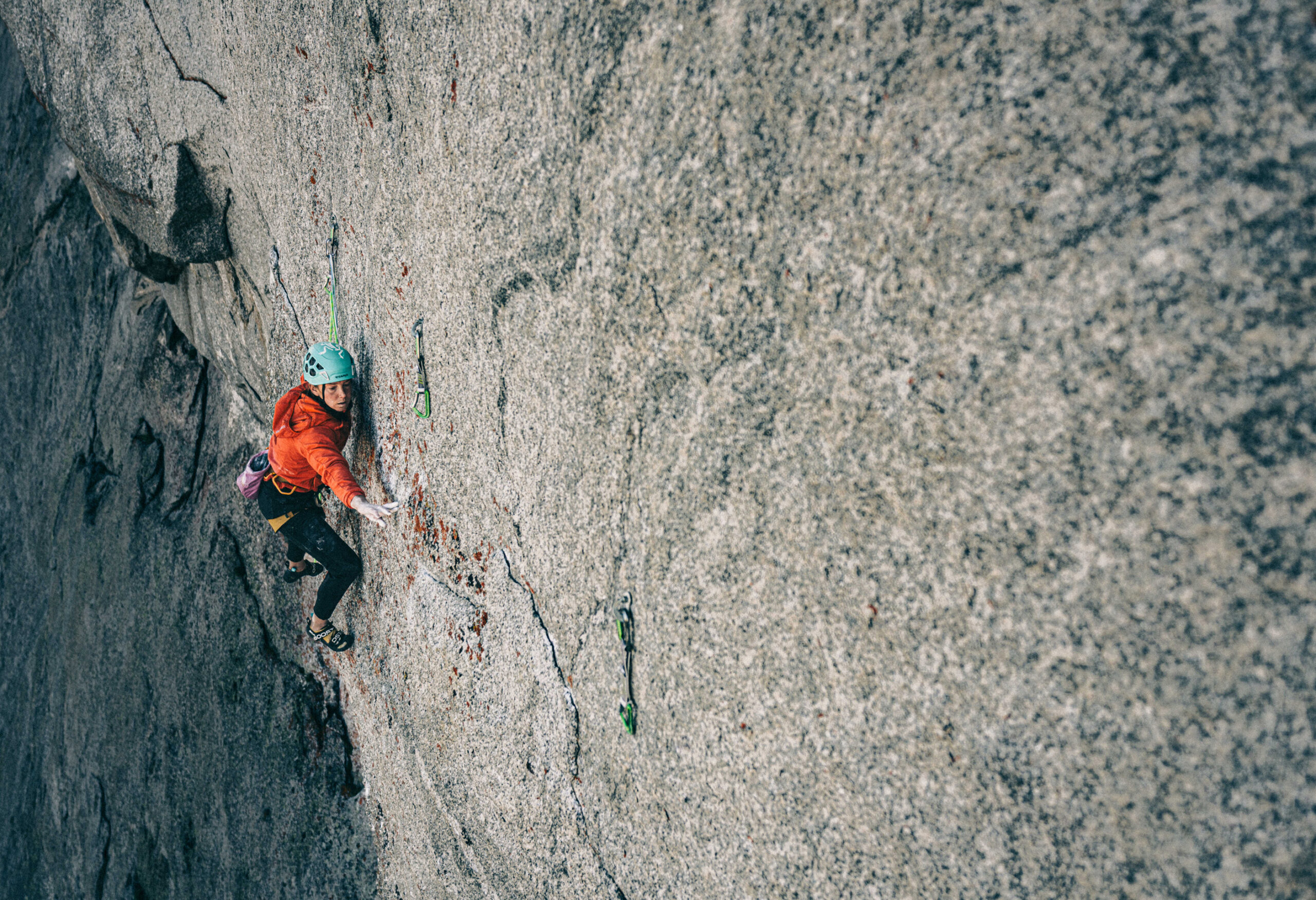
Pitch 4, 5.13b
The gesture says something about how climbing history actually lives — not in guidebooks or competition results, but in the mountains themselves. In a piece of gear left behind by a teenager decades ago who couldn’t have known that someone like Amity would one day stand in the same spot, asking the same wall the same questions.
“Being part of this incredible place, being part of this history and sharing these experiences with amazing people,” says Amity, “these are the things that are so integral to making climbing accomplishments meaningful. It’s cool to have little reminders of that.”